
Your Product Isn’t the Problem. Your Positioning Is.
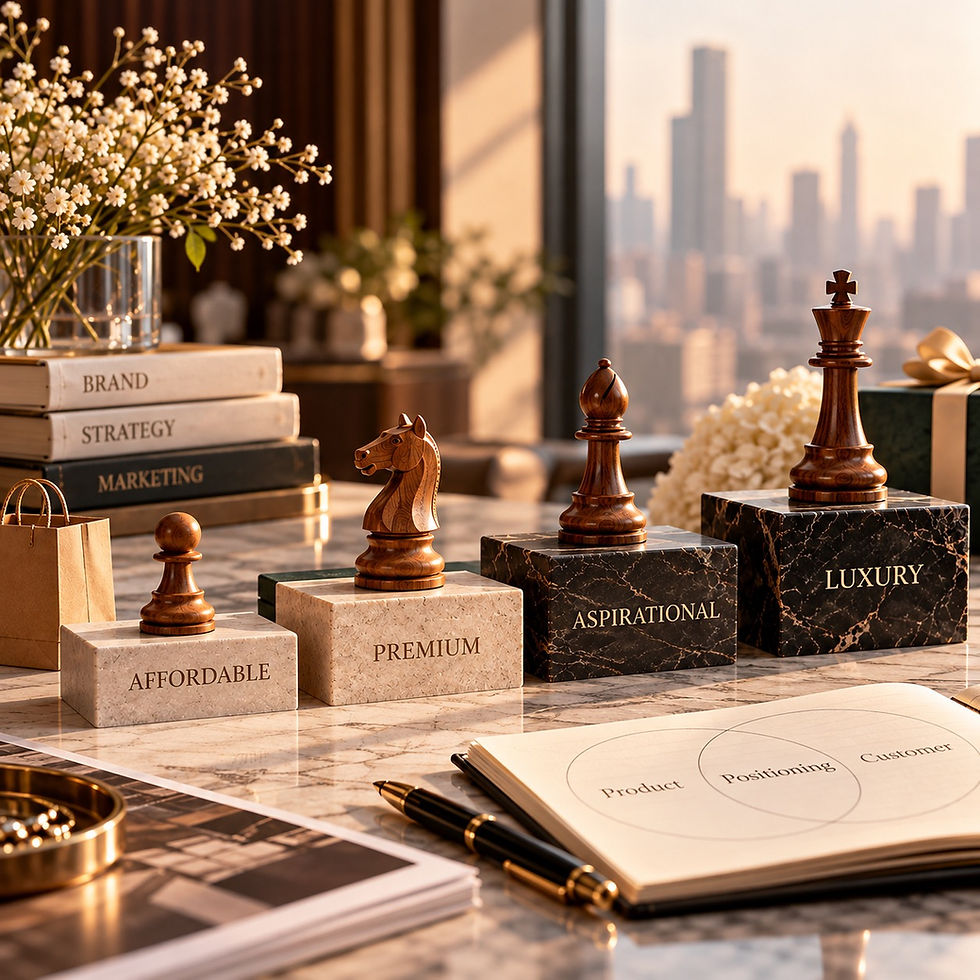
A founder comes to us with a familiar complaint. The product is good, customers who buy it love it, and the reviews are strong. But sales are flat, marketing spend keeps rising, and every campaign seems to attract the wrong people: customers who haggle, wait for discounts, or compare the brand with options half its price.
The instinct is to fix the product, add features, or cut the price. Usually, none of that is needed. What’s missing is a clear answer to one question:
Who is this brand for, and where does it sit in their mind?
That’s positioning. When it’s unclear, even an excellent product looks ordinary.
What positioning actually means
Positioning isn’t a tagline or a logo. Marketing strategists Al Ries and Jack Trout popularised the idea decades ago with a simple observation: positioning isn’t what you do to a product, it’s what you do to the mind of the customer. It’s the place your brand occupies when someone compares you with alternatives.
Every customer is constantly sorting brands into mental categories: cheap and reliable, worth saving up for, a treat, a status symbol. If you don’t decide which category you belong in, customers will decide for you, usually based on your weakest signal. That might be a discount banner, a poorly designed package, or a slow reply to a WhatsApp message.
The four positions, and what each one demands
Most consumer brands fall broadly into one of four positions. None is better than another, and plenty of businesses build excellent companies in each one. The mistake is wanting the margins of one while sending the signals of another.
1. Affordable
The promise: Good value. You get what you need at a price that feels fair or better.
What the customer is buying: Reliability, convenience, and the satisfaction of a smart purchase.
What the brand must deliver:
Prices that are visibly competitive and easy to compare
Wide availability, through marketplaces, many retail points, and quick delivery
Clear, functional communication focused on benefits, value, and proof
Operational efficiency, because margins are thin and the business only works at volume
Where it goes wrong: Affordable brands that try to look luxurious often confuse customers and raise their costs without raising their prices. In this position, efficiency is the brand.
2. Premium
The promise: Better than the standard option, with a price that’s justified by quality.
What the customer is buying: Superior materials, performance, design, or service, and the confidence that comes with them.
What the brand must deliver:
A clear, explainable reason for the higher price, such as ingredients, craftsmanship, durability, or expertise
Visual identity and packaging that look considered and consistent
Customer service noticeably better than the mass-market alternative
Marketing that educates, explaining why the product is better rather than just claiming it is
Where it goes wrong: Premium brands drift downmarket through frequent discounting. If customers learn that the “real” price is 30% lower during a sale, the premium justification collapses.
3. Aspirational (sometimes called “masstige”)
The promise: A taste of the elevated life, within reach.
The term “masstige,” short for mass prestige, was coined by Michael Silverstein and Neil Fiske in their book Trading Upto describe brands that let middle-income customers buy into a premium experience without luxury-level prices.
What the customer is buying: Identity and emotion. The purchase says something about who they are, or who they’re becoming.
What the brand must deliver:
Strong storytelling and lifestyle imagery, because the brand sells a feeling as much as an object
An entry-level product that makes the brand accessible, alongside higher-priced pieces that keep it desirable
Careful use of influencers and collaborations, with people the target customer admires rather than simply people with large followings
A shopping experience that feels special, including packaging, unboxing, and personal touches
Where it goes wrong: Aspirational brands sit in the most delicate position. If they lean too far toward mass availability, the aspiration disappears. If they lean too far toward exclusivity, they price out the customers they were built for.
4. Luxury
The promise: Rarity, heritage, and meaning beyond function.
What the customer is buying: Status, craftsmanship, exclusivity, and belonging to a world few can enter.
Jean-Noël Kapferer and Vincent Bastien, in The Luxury Strategy, argue that luxury follows “anti-laws” of marketing. Many rules that grow ordinary brands actively damage luxury ones.
What the brand must deliver:
Controlled availability: limited editions, selective distribution, sometimes waiting lists
Pricing that’s rarely, if ever, discounted
A distinctive aesthetic that stays consistent over years, not one that chases trends
A story of origin, craft, or vision that can’t easily be copied
Service that feels personal and unhurried
Marketing that seduces rather than persuades, and rarely talks about price at all
Where it goes wrong: Luxury is the hardest position to hold and the easiest to lose. A single season of heavy discounting, mass marketplace listings, or careless collaborations can undo years of brand-building.
Positioning has to run through everything
The most common mistake isn’t choosing the wrong position. It’s choosing one in a strategy meeting and then letting every other decision contradict it.
Customers don’t read your positioning statement. They experience your brand through dozens of small signals, and every one of them either reinforces or undermines the position you’ve chosen.
Touchpoint | Affordable | Premium | Aspirational | Luxury |
Pricing | Competitive, transparent | Higher, justified | Tiered, with an entry point | High, rarely discussed |
Discounts | Frequent, expected | Rare, strategic | Occasional, curated | Almost never |
Channels | Everywhere | Selective retail, own website | Own website, curated retail, social | Flagship, invitation, select partners |
Visual identity | Clean, functional | Refined, consistent | Lifestyle-led, emotive | Distinctive, timeless |
Packaging | Practical | Quality, branded | Experiential, giftable | Ritualistic, memorable |
Communication | Value and benefits | Quality and expertise | Identity and lifestyle | Heritage, craft, meaning |
Customer service | Fast, efficient | Knowledgeable | Warm, personal | Bespoke, anticipatory |
When one of these is out of line with the rest, customers notice even if they can’t say why. A beautifully shot Instagram feed loses its effect if the order arrives in a plain courier pouch. A luxury price tag is hard to defend while the brand runs “flat 50% off” ads.
The signs your positioning is broken
You probably have a positioning problem, not a product problem, if:
Your customers compare you with brands you don’t consider competitors. If shoppers measure you against cheaper alternatives, your signals are pointing them there.
You need discounts to move stock. Constant discounting usually means customers don’t see enough value at full price, which is a perception gap, not necessarily a product gap.
Different team members describe the brand differently. If your founder, your designer, and your sales team would each give a different answer to “what are we?”, customers are getting mixed messages too.
Your marketing gets reach but not conversions. Attention without sales often means the message is attracting people who were never your customer.
You attract the wrong kind of customer. Heavy bargaining, high return rates, or complaints about price can all suggest you’re being found by the wrong segment.
How to decide on your position
Choosing a position isn’t about ambition (“we want to be luxury”). It’s about fit. Work through these questions honestly:
What can your product genuinely support? Luxury requires craft, rarity, or heritage you can actually demonstrate. Premium requires a quality difference customers can perceive. Don’t claim what you can’t deliver consistently.
What can your economics sustain? Affordable positioning needs volume and efficient operations. Luxury needs patience, because building desirability takes years and early sales may be slow. Make sure your cash flow can support the position you choose.
Who is your customer, specifically? Not “women aged 25 to 45,” but what they value, where they shop, whose taste they trust, and what they’re willing to pay for.
Where is there space? Map your competitors by price and perceived value. Sometimes the strongest position is the gap nobody occupies.
Can you hold it for years? Positioning works through consistency. If you’re likely to abandon a position the first time sales dip, choose one you can commit to.
Then write it down in one or two sentences, a positioning statement, and use it as a filter for every decision about design, pricing, channels, partnerships, and hiring.
A word on repositioning
Brands can change position, but moving up is much harder than moving down. A brand that drops from premium to affordable can do so almost overnight by cutting prices. A brand that moves from affordable to premium has to undo years of customer perception, often while losing existing customers before the new ones arrive.
If you’re considering a repositioning, three approaches tend to work better than a sudden switch:
Launch a separate line or sub-brand for the new position, rather than stretching the existing brand.
Move gradually with consistent upgrades to product, packaging, and communication over several quarters.
Reduce discounting first, before raising prices or changing the identity, so the new position has a credible base.
The bottom line
A good product in the wrong position will struggle. An average product with a clear, consistent position will often outperform it. That isn’t because customers are fooled. It’s because a clearly positioned brand makes the choice easy: customers know what it stands for, what it costs, and whether it’s for them.
So before you redesign the product, rework the features, or slash the price, ask the harder question first: Do we know what we want to be, and does everything we do say so?


Comments